In the high-stakes world of modern serious oversteer competition, podium finishes is far more than exclusively a product of sheer torque or pilot aggression. Rather, it has become a complex science which necessitates a scrupulous fusion of selecting a proven chassis, arming it with the highest-quality competition components, and, most essentially, grasping its real-time performance on the track through advanced drift telemetry software. This definitive handbook acts as your blueprint from the very first concept of a drift build through to the last telemetry-optimized tweaks that turn a capable vehicle into a repeatable podium finisher. We will delve deep into the art and science of car suspension tuning, showing how a modern drift tuning app like GripDial eliminates approximation and provides unparalleled visibility into your chassis's true behavior.
The foundation of any exceptional competitive sliding vehicle is, without question, the platform itself. A select group of vehicles have earned legendary standing within the global drifting culture due to their natural balance, strong construction, and the enormous range of specialist support available. Choosing the correct platform is the initial and most important selection a driver will make. For instance, the BMW's E36 3 Series is widely regarded as among the greatest balanced drift cars of history. Its almost ideal evenly distributed mass, alongside a rear-wheel-drive setup and bulletproof inline-six engines, creates a chassis that is at once forgiving for novices and highly competitive in the control of a pro competitor. The evolution of this concept, the BMW E46 platform, refines these strengths with a even more sophisticated chassis, wider wheel track for improved stability, and still increased steering angle directly from the manufacturer. A distinct powerful contender in the top-level arena is the Corvette C6.
This V8-powered sports car introduces a particular array of advantages to the sideways discipline, such as a light aluminum frame, a rear-mounted transaxle that helps create an perfect front-to-rear mass ratio, and the immense torque of a powerful GM LS engine. This fusion renders it an utter weapon on track, designed of initiating and holding extended angles with relatively effortless application of acceleration. For those looking for remarkable value, the 350Z model Nissan rises above as a excellent example. It comes from the manufacturer with a rigid body structure, a decent OEM limited-slip differential, and the responsive VQ35DE motor that offers plenty of horsepower and torque for learning and moving up in the discipline. Its newer version, the 370Z model, offers further advancements in structural rigidity, steering geometry, and peak motor performance, solidifying its place as a popular pick among serious drivers. Further legendary platforms that merit attention include the lightweight Wankel-engined Mazda FC RX-7, the ubiquitous S13 Silvia/240SX, the V8-powered Ford SN95, the modern E90 3 Series, and the compact yet incredibly engaging and forgiving Mazda Miata. Every single one of these chassis gives a distinct array of characteristics, difficulties, and potentials, but they all have in common the core elements required to be transformed into a serious sliding vehicle.
However, choosing the optimal chassis is only the starting point. To unlock the true potential of any of these vehicles, major changes to the steering system and damping and springing systems are completely mandatory. This is where the realm of precision drift-spec hardware becomes vital focus. The one most impactful modification for a dedicated competition vehicle is the installation of a drift-spec steering angle kit. These engineered systems, like those developed by specialist companies like SLR, are engineered to radically increase the car's maximum lock-to-lock rotation. A standard road car is severely constrained in how far its steering tires can turn, a safety trade-off for on-road operation. In drifting, but, extreme steering input is continuously necessary to catch and sustain a slide. An modification kit substitutes the OEM hubs, rod ends, and potentially suspension arms with pieces that allow the front tires to achieve degrees of turn beyond 70 or even 80 degs, as opposed to a normal factory limit of around 40 to 50 °.
This immensely greater steering angle gives the operator with exponentially greater authority during a angle, allowing it to be much simpler to initiate a slide, sustain it through a long corner, and switch seamlessly from one side to the opposite. The difference in drivability is nothing short of transformative. Combined with a correctly specified angle kit is the just as vital upgrade to the car's spring and damper setup. Off-the-shelf or even premium sport coilovers are just not engineered for the particular and brutal needs of drifting. A purpose-built system of suspension units is paramount. These engineered suspension components have unique piston tuning and spring stiffness that are tuned for the violent weight transfer that is characteristic of sliding. When a pilot starts a slide, the car's weight is transferred rapidly to the outside of the bend. Optimal competition dampers handle this shift in a predictable way, permitting the vehicle to settle promptly and offering the driver clear feedback through the steering wheel and seat. They additionally enable precise setting of stance, shock absorber stiffness, and corner weighting, which are all fundamental elements of optimizing the car's behavior to a specific venue or piloting style. Together, a high-quality drift angle kit and a expertly selected set of performance adjustable dampers are the undeniable hardware cornerstone upon which all subsequent optimization is built.
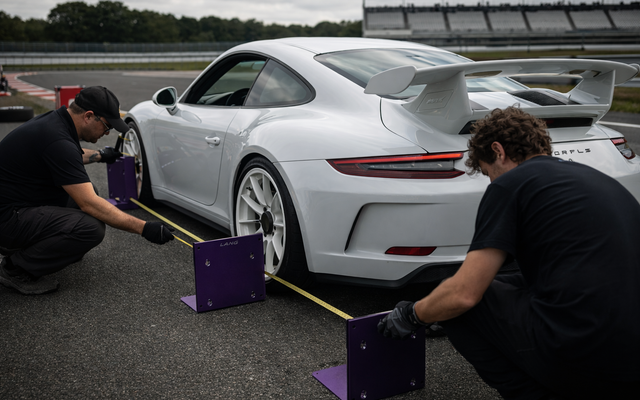
Once the fundamental components is installed, the subsequent critical phase in the development is the detailed adjustment of the car's alignment. This is the world of car suspension tuning, a methodology that can appear daunting to the newcomer but is, in practice, the key to transforming a assembly of capable parts into a unified and predictable whole. The most debated parameter of alignment for sliding is definitely camber. Camber angle is the angle of the tire compared to the vertical plane when viewed from the forward of the car. When the top edge of the wheel is angled towards the car, this is called camber-in. For sliding, negative camber on the front tires is universally used and is considered critical. The logic is deeply related to vehicle dynamics.
When a car is going around a bend at high slip angles, the frame rolls to the outer of the corner. This lean causes the outside front wheel to reduce its best footprint with the asphalt. By drift tuning app adding inward lean, the wheel is pre-leaned to counteract this lean. As the chassis rolls into the bend, the outside front tire flattens out with the track, increasing its traction at the critical point when it is most required for steering authority. Typically, front axle adjustments for a serious sliding vehicle fall between approximately drift tuning app -3 degrees to as much as -5 degrees or even more, based on the parameters of the chassis geometry, compound choice, and pilot style. The rear wheels also utilize inward lean, but the settings are generally less and less aggressive than the front axle. Overly aggressive negative camber at the back can cause the vehicle to excessively loose and challenging to control on power application, as it diminishes the effective contact patch of the powered tires during straight-line power delivery. Hence, rear axle adjustments are often in the ballpark of -1 degree to -3 degrees, striking a delicate equilibrium between providing adequate cornering bite to assist in entering and maintaining the drift while simultaneously preserving good hook-up for exiting the bend. camber angle is merely one element of the more complex tuning equation, which also encompasses toe, self-centering steering, and bump steer modification.
Toe setting describes the angle of the wheels when looked at from the top. Positive toe means the front edges of the tires are closer together than the rear edges, while negative toe means the converse. For oversteer, a modest amount of front negative toe is frequently used to improve the turn-in steering response, making the vehicle feel more agile and ready to initiate a drift. Rear axle toe angle is usually set to zero or a very slight amount of positive toe to foster straight-line stability under throttle. caster angle is the forward or aft inclination of the kingpin axis when observed from the lateral of the vehicle. More positive caster improves steering feel and high-speed confidence, and it additionally increases camber increase during steering, which is highly beneficial. Setting these values is a complex interaction where a adjustment to one setting can and often will influence the other settings. The conventional process for dialing in a car's alignment for drifting has historically been a labor-intensive process of experimentation and feeling. A driver or team would apply a modification based on a hunch, drive the vehicle on track, rely on the driver's personal perception and comments, and then apply a further change. This loop would continue again and again until the chassis felt "right" or the available practice time ended. This approach is not just extremely inefficient in terms of hours and resources, but it is also inherently flawed.
Pilot perception is a notoriously subjective data source, colored by countless elements such as tiredness, evolving track grip levels, ambient heat, and simply the focus of the driver on that given session. What feels "oversteery" on one run might feel "tight" on the next lap, causing confusing data and counterproductive adjustments. This age-old limitation in chassis setup is precisely where modern technology has stepped in to revolutionize the landscape.
The development and integration of advanced drift telemetry software has introduced a completely new paradigm for engineering and perfecting professional drift cars. These systems, showcased by innovative products like data acquisition tools, function by directly measuring the real-time mechanical movement of the car as it is piloted on the course. Unlike using driver feedback, these devices collect quantifiable metrics on essential parameters such as shock absorber movement, corner velocities, lateral and longitudinal g-forces, steering angle, and throttle and brake position. This raw telemetry is then interpreted by sophisticated software that can plot and interpret the data in a clear format. For the very first time, drivers and crews can observe precisely what the car is exhibiting at any given point of a drift. This function changes the complete alignment optimization workflow. Imagine the specific task of setting the front axle negative camber for a given chassis. As an alternative to making a modification from -3 degrees to -3.5 degrees and then driving multiple laps to try and "perceive" a difference, a vehicle dynamics tool can deliver real-time and definitive data. The tool can display graphically how the suspension's grip is acting during the most important moments of a slide: the initial flick, sustain, and transition. It can show if the existing value is allowing the outside front tire to keep ideal grip or if the compound is overloaded on its external edge.
The tool can subsequently provide empirical suggestions for change. Perhaps the data shows that the outside front tire is still overloading its outer shoulder at -3.5 degrees of negative camber, indicating that even more inward lean, say -4 degrees, might be warranted. Alternatively, the information might indicate that the tread is failing to coming up to heat or that the inside shoulder is wearing too quickly, which could indicate that there is too much negative camber and a slight decrease back to -3.2 degrees would be more optimal. This level of accuracy and useful analysis was simply unattainable in the days of pure manual adjustment.
The effect of using a comprehensive vehicle dynamics tool reaches much further than only setting camber. It becomes an invaluable suspension tuning guide that is tailored to your exact chassis. When fine-tuning the rebound and compression clickers on your coilovers, rather than depending on vague advice or copying another team's settings, you can utilize the software to see how the car is behaving in relation to your tweaks. The application can graph the suspension travel path over a run, showing if the coilovers are controlling the weight transfer optimally or if they are allowing the chassis to bounce uncontrollably after a flick. It can assist in pinpointing challenges like bottoming out or topping out, enabling you to apply educated adjustments to spring preload, rebound/compression values, or stance. This methodology extends similarly to the detailed process of corner balancing. In addition to camber, the tool can give data into how adjustments to toe and caster are influencing the car's balance during different maneuvers of a drift. For instance, it can help you to find the optimal amount of front axle toe-out for your individual angle kit setup and driving approach by analyzing the quickness of initial reaction and the stability of the vehicle at maximum steering angle. This transforms the system an exceptionally effective vehicle dynamics manual that is dynamically updated by the live dynamics of your personal car on the tarmac. It moves the complete endeavor from a subjective skill into a methodical engineering procedure.
Additionally, the application of a platform like GripDial is in no way restricted to expert teams with extensive resources. For the grassroots competitor, it acts as an amazing equalizer. It effectively gives the tuner with the insight of a full-time suspension specialist without the corresponding cost. It speeds up the development time by providing clear directions to questions that would normally take years of experimentation to understand. A builder can understand how their individual chassis responds to various settings, developing a more profound understanding of vehicle dynamics in the process. It additionally opens drift tuning app up professional suspension engineering concepts, enabling all drivers with the ambition to perfect their car to do so in a structured and effective fashion. This is notably significant in a discipline like oversteer competition, where tuning know-how has traditionally been a highly secretive advantage among professional drivers. Now, that power can be in the toolkit of every serious builder.
In conclusion, the journey to building and dialing in the perfect high-performance drift car is a multi-stage mission that perfectly combines classic mechanical principles with cutting-edge data tools. It commences with the wise pick of a legendary chassis, then built upon the application of essential drift-spec hardware like maximum-angle drift angle kits and expertly valved performance coilovers. The build then advances into the detailed stage of chassis dynamics adjustment, where parameters like camber, toe, and caster angle are precisely adjusted to suit the vehicle's modified geometry and the driver's personal style. Ultimately, and what really distinguishes the contemporary approach from the old ways, is the adoption of a advanced vehicle dynamics tool. This platform eliminates the uncertainty and trial and error of purely seat-of-the-pants tuning by providing empirical, real-time telemetry on how the chassis is actually behaving. It functions as an indispensable suspension tuning tool, a actionable drift suspension tuning guide, and a comprehensive vehicle dynamics tool. As a complete package, this integrated approach guarantees that each and every aspect of the competition vehicle—from the pick of the platform to the last adjustment on the coilover—is perfected for peak performance on the competition venue. It signifies the complete maturation of the art of oversteer driving, connecting physical pilot talent with precise suspension engineering to build the perfect dominant vehicles possible.